The La Jolla tide pools run along a few miles of sandstone and volcanic rock, from Dike Rock just north of Scripps Pier to the reefs at Windansea. The National Park Service, which points visitors here as an alternative to Cabrillo, lists sea anemones, crabs, limpets, octopuses, sea stars, sea slugs, sea hares and barnacles among the animals you might find when the tide is out. Getting a good look comes down to three things: going on a real low tide, picking a stretch of shore that is actually open, and leaving everything where you found it. This guide covers all three, with NOAA's lowest daylight tides for the rest of this season.
Where the La Jolla tide pools are
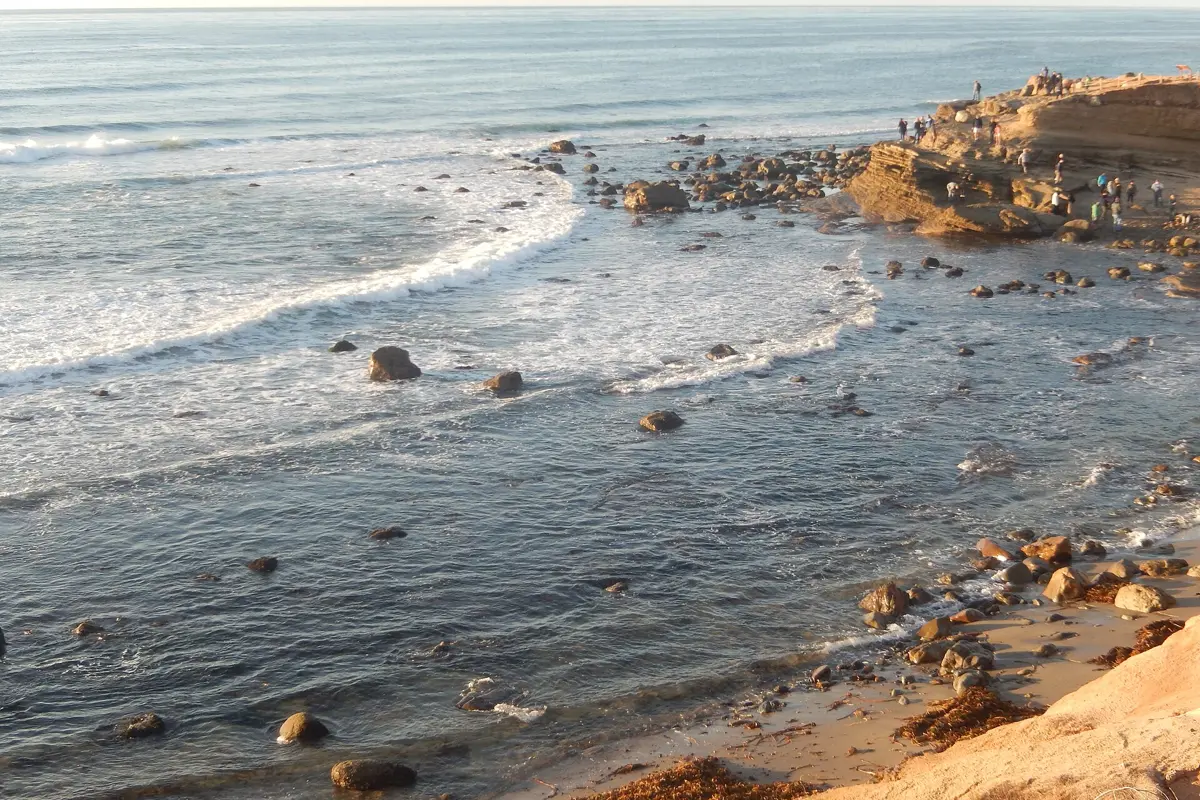
Tide pools form wherever flat rock is exposed at low water, so "the La Jolla tide pools" is really a string of separate spots. Each has its own access, crowd level and rules. From north to south:
Dike Rock, north of Scripps Pier (La Jolla Shores tide pools)
If you searched for La Jolla Shores tide pools, this is the place you want. La Jolla Shores itself is a long sandy beach, so the rocky pools start at its north end. Walk north along the sand from La Jolla Shores, pass under Scripps Pier and continue to the rock bench beyond it. The San Diego Tourism Authority describes Dike Rock as a volcanic bench where you can look for sea stars, limpets, mussels, anemones and the occasional octopus. It is also where Birch Aquarium runs its guided tide pool walks (see below), and it tends to be quieter than the Village end of town.
Two cautions. This walk is on sand below bluffs, and a rising tide narrows it quickly, so start back before the water turns. And the shore north of the pier is the San Diego-Scripps Coastal State Marine Conservation Area, where CDFW prohibits taking or damaging any marine life or rock except a narrow hook-and-line exception for a few open-water fish.
La Jolla Cove and Shell Beach
La Jolla Cove is better known for snorkeling, which we cover in our snorkeling La Jolla guide, but the rocks around its edges hold pools too. Know where you can't go: the City of San Diego closed Point La Jolla and Boomer Beach, the rocky point just west of the Cove, year-round in 2023 to protect California sea lions. Signs and barriers mark it. Our guide to the La Jolla sea lions shows where you can watch them from the walkway instead.
South of Ellen Browning Scripps Park, a stairway drops to Shell Beach, a small cove with rock shelves on both sides. Seal Rock sits just offshore, and the tourism authority notes that harbor seals haul out there at low tide when the surf is down. The stairs and the wet rock at the bottom are the hard part, so judge them before bringing small children.
Coast Boulevard and the Children's Pool
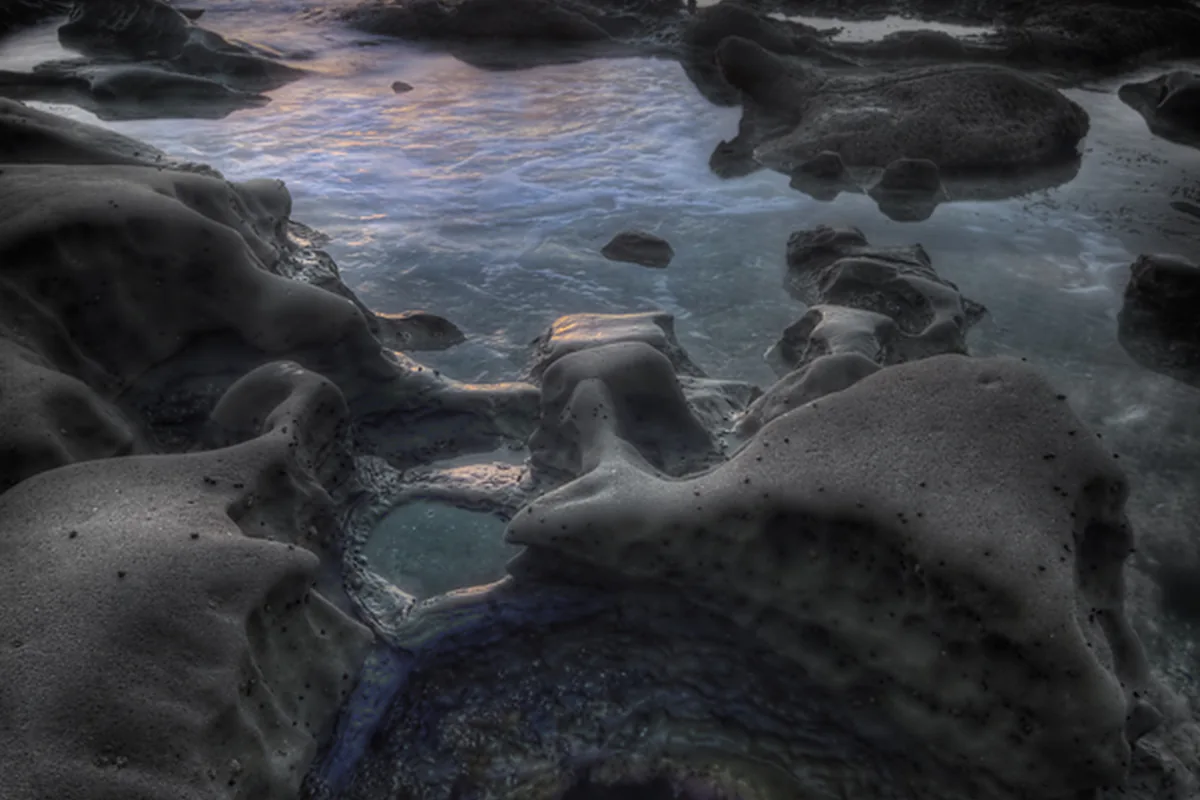
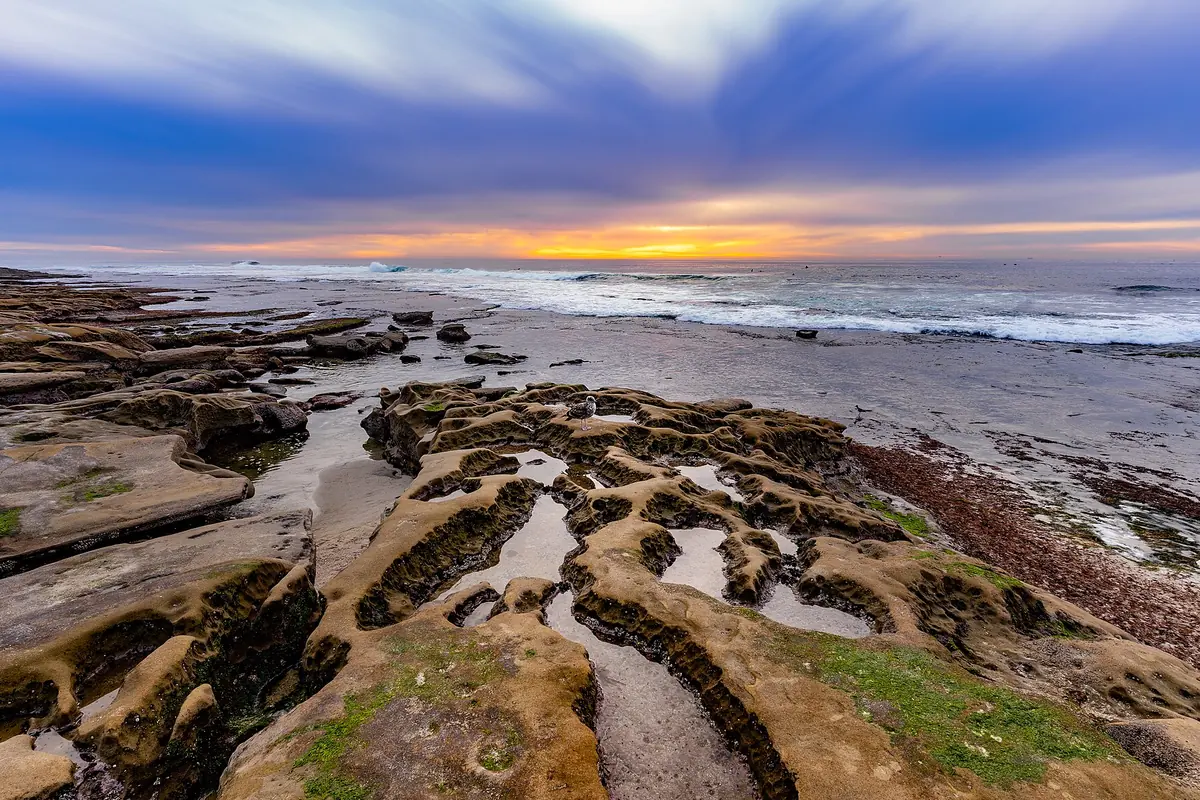
The reef flats along Coast Boulevard are the easiest La Jolla tide pools to reach from the Village. This is the stretch most people mean when they say "La Jolla tide pools": wide, pocked sandstone that turns into a maze of little pools at a minus tide, like the scene in the photo above.
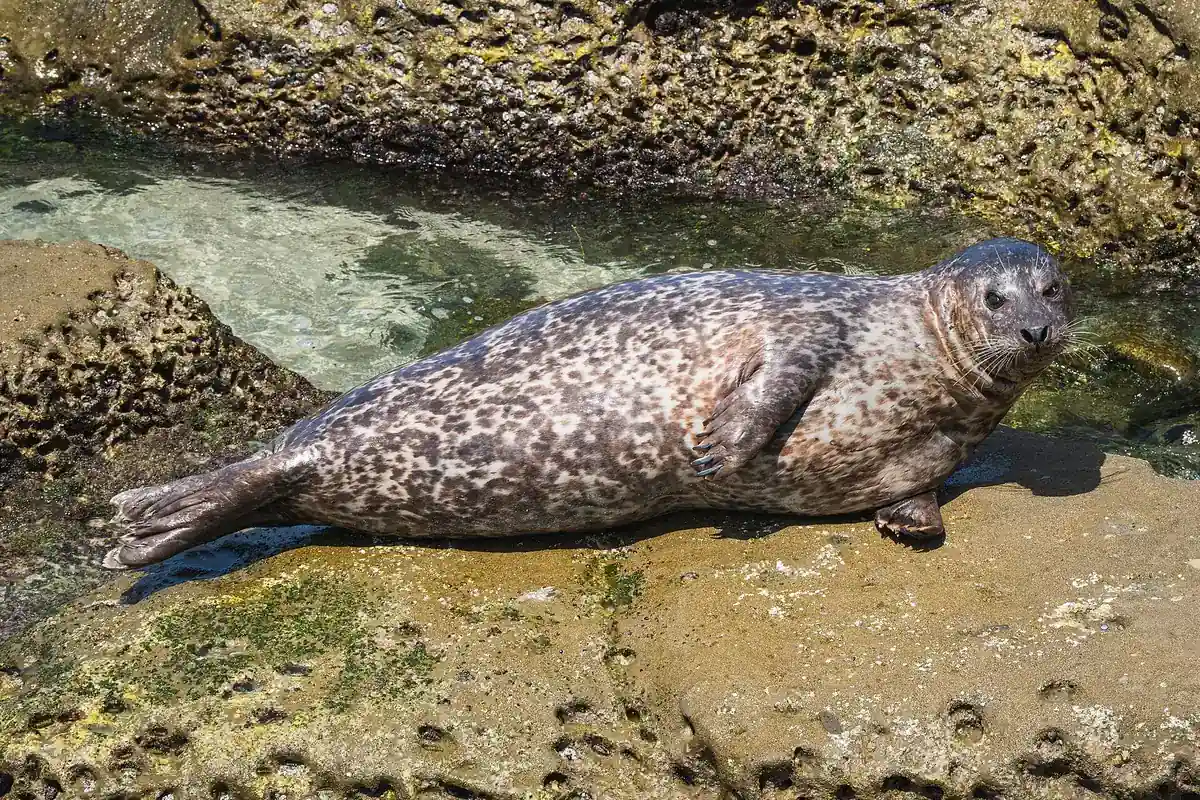
The Children's Pool, the beach behind the 1931 seawall, is a different story. The City's lifeguard page says the beach is closed to public access during harbor seal pupping season, December 15 through May 15 each year. You can still watch from the seawall and the walkway above. Our La Jolla harbor seals guide covers the best viewing spots and the distance rules.
Windansea and south toward Bird Rock
The NPS places Windansea at the southern end of La Jolla's tide pool coast. The City describes it as a reef-and-rock beach with potentially severe shore break, so it is a place for calm-day low tides only. Just south of Windansea, the South La Jolla State Marine Reserve begins and runs past Bird Rock. CDFW says it protects rocky and sandy intertidal habitat and lists tidepooling among the ways to enjoy it. The Bird Rock shore is mostly reef with limited access and no lifeguards.
Best time to visit the La Jolla tide pools
Go on a low tide, not just in the morning or afternoon. Tide heights at La Jolla are measured from mean lower low water (MLLW), so a "0.0 ft" tide is an average low, and a minus tide like -1.5 ft uncovers rock that is underwater most of the month. Plan to arrive about an hour before the predicted low and leave as the water comes back.
Season changes the clock. Late fall and winter bring the lowest tides of the year in daylight, in the early-to-mid afternoon. In late spring and summer the lowest lows move to before dawn: when we pulled NOAA's predictions for May through July 2027, every low of -1.0 ft or lower fell between about 2 and 7 a.m.
Lowest daylight low tides, November 2026 to March 2027
We pulled NOAA's high/low predictions for the La Jolla station at Scripps Pier (9410230) and kept every low of -0.5 ft or lower that falls at least half an hour after sunrise and half an hour before sunset. They cluster into windows a few days long, around the new and full moons. The time shown is the lowest tide in each window.
| Window | Lowest predicted | Time of that low | Sunset that day |
|---|---|---|---|
| Nov 22–25, 2026 | -1.5 ft (Nov 25) | 3:55 p.m. | 4:43 p.m. |
| Dec 7–9, 2026 | -0.7 ft (Dec 8) | 3:11 p.m. | 4:42 p.m. |
| Dec 21–24, 2026 | -1.9 ft (Dec 24) | 3:47 p.m. | 4:48 p.m. |
| Jan 4–9, 2027 | -0.8 ft (Jan 6) | 3:00 p.m. | 4:57 p.m. |
| Jan 18–24, 2027 | -1.9 ft (Jan 21) | 2:48 p.m. | 5:10 p.m. |
| Feb 3–7, 2027 | -0.7 ft (Feb 5) | 3:02 p.m. | 5:25 p.m. |
| Feb 16–22, 2027 | -1.6 ft (Feb 19) | 2:24 p.m. | 5:37 p.m. |
| Mar 17–21, 2027 | -1.0 ft (Mar 19) | 2:18 p.m. | 6:59 p.m. |
The late-December and mid-January windows are the standouts, with predicted lows near -1.9 ft. The November 23–25 window lines up with the California King Tides Project dates, so the same days bring very high morning tides; our San Diego king tides guide explains how to watch those safely. Predictions are not a safety forecast: big surf can wash over rock even on a minus tide. Check the exact time on NOAA's La Jolla tide predictions or the tide widget on our homepage before you go, and stay off the rocks if waves are reaching them.
Winter lows land close to sunset, which makes for great light and a fast-fading walk back. Bring a headlamp if your low is within an hour of sundown.
What you'll see in La Jolla's tide pools
Most visitors start with the obvious animals and miss the small ones. Slow down and look into a single pool for a few minutes.
- Anemones. Green, tentacled cups in the pools and closed-up blobs covered in sand and shell bits on the drier rock. Don't poke the closed ones; they are holding water to survive until the tide returns.
- Crabs and hermit crabs. Shore crabs dart under ledges; hermit crabs trundle across pool bottoms in borrowed snail shells.
- Limpets, mussels and barnacles. They cover the higher rock. Step on bare rock instead of on them.
- Sea hares and sea slugs. Sea hares are large, soft and brownish; nudibranchs are tiny and brightly colored. Both are easy to overlook in seaweed.
- Sea stars and octopuses. Less common and usually tucked into cracks at the lowest tides. If you find one, enjoy it without touching.
Birds work the same rocks. Watch for gulls, shorebirds and cormorants feeding as the water drops.
Rules: why you can't take anything
Much of La Jolla's shore sits inside state marine protected areas. In the Matlahuayl State Marine Reserve (the Cove to the Shores) and the South La Jolla State Marine Reserve (from just south of Windansea past Bird Rock), CDFW makes it unlawful to injure, damage, take or possess any living, geological or cultural marine resource. That includes empty shells and rocks. North of Scripps Pier, the conservation area rules are nearly as strict. On the stretches between the reserves, such as the Coast Boulevard reefs, state regulations still bar taking tidal invertebrates from tide pools and the shore just below them, with a short list of exceptions for licensed fishing (California Code of Regulations, Title 14, section 29.05), and the NPS asks visitors to remove nothing, living or dead. Our guide to the La Jolla ecological reserve sorts out the names and boundaries.
The practical version:
- Look, photograph and leave everything in place, alive or dead.
- If you turn over a rock, put it back the way it was, gently. Better yet, don't flip rocks at all.
- Keep at least 50 yards from seals and sea lions, the distance NOAA recommends and the City repeats in its sea lion guidance.
- Stay out of closed areas, even when the rock below looks walkable.
Safety and what to bring
- Grippy, closed-toe shoes. The NPS strongly discourages sandals and flip-flops; algae-covered rock is slick.
- Face the ocean. Keep an eye on incoming sets, and never turn your back on the water on an outer ledge.
- Know your exit. Note the stairs or ramp you came down, and start back before the tide turns, especially on the sand walk to Dike Rock.
- Check water quality. After rain, look at the County's beach and bay water quality map before wading.
- Ask a lifeguard. La Jolla Cove and La Jolla Shores have permanent City lifeguard stations, and the guards know which stretches are getting surf that day.
Guided tide pool walks
For a first visit with kids, a guide helps. Birch Aquarium at Scripps runs a Tidepooling Adventure on select Saturdays and Sundays through December 2026, led by an aquarium educator. Reservations are required, participants must be at least 6, and the aquarium lists it at $25 for the public and $20 for members, not including admission. Check Birch Aquarium's program page for current dates, then pair it with a visit to Birch Aquarium itself.
More tide pools near La Jolla
If La Jolla is crowded or the surf is up, Cabrillo National Monument on Point Loma has a ranger-staffed rocky intertidal area; our Cabrillo tide pools guide covers how to plan a visit. For a county-wide comparison, see our 10 San Diego tide pool spots or start at the San Diego tide pools hub. A bluff-top stroll on the La Jolla Coast Walk Trail is a good fallback on a high-tide day.
Questions before you go
When is the best time to see the La Jolla tide pools?
On a minus low tide in daylight. In late fall and winter those come in the early-to-mid afternoon; NOAA predicts lows near -1.9 ft at La Jolla on December 24, 2026 and January 21, 2027. In summer the lowest tides fall before dawn.
Are there tide pools at La Jolla Shores?
The Shores is mostly sand. The nearest tide pools are at Dike Rock, a rock bench reached by walking north along the beach past Scripps Pier at low tide.
Where do you park for the La Jolla tide pools?
For Dike Rock, park at La Jolla Shores (the Kellogg Park lot fills quickly on summer weekends). For the Cove, Shell Beach and Coast Boulevard reefs, look for street parking in the Village and arrive early.
Can you take shells or rocks from the La Jolla tide pools?
No. Much of the shore lies in state marine protected areas where taking anything, living or dead, is unlawful, and state rules protect tide pool invertebrates between the reserves too.
Is the Children's Pool open?
The City closes the Children's Pool beach to the public from December 15 through May 15 for harbor seal pupping season. You can watch the seals from the seawall and walkway above year-round.
Are the La Jolla tide pools free?
Yes. There's no fee to walk the shore. Parking and guided programs such as Birch Aquarium's Tidepooling Adventure cost extra.
Sources & further reading
Official information and references for this guide. Check the source for current access, rules and conditions.
- La Jolla Tidepools and The Children's Pool – National Park Service
- A Guide to Six of San Diego County's Best Tide Pools – San Diego Tourism Authority
- La Jolla Reefs – San Diego Tourism Authority
- Children's Pool – City of San Diego Lifeguard Services
- Point La Jolla – City of San Diego
- Year-Round Closure of Point La Jolla and Boomer Beach, addendum (2023) – City of San Diego
- Windansea – City of San Diego Lifeguard Services
- La Jolla Cove – City of San Diego Lifeguard Services
- Kellogg Park – City of San Diego
- Matlahuayl SMR and San Diego-Scripps Coastal SMCA – CDFW
- South La Jolla SMR and SMCA (boundaries and regulations) – CDFW
- Invertebrate fishing regulations, 14 CCR 29.05 – CDFW
- Tide predictions, La Jolla station 9410230 (Nov 2026 to Jul 2027 high/low data) – NOAA CO-OPS
- Tidepooling Adventure – Birch Aquarium at Scripps
- Beach and Bay Water Quality – County of San Diego
- Children's Pool Beach, Scripps Pier and Windansea Beach coordinates – Wikipedia